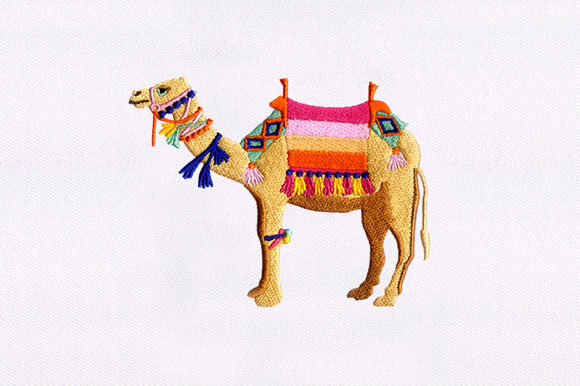
Camel Embroidery Design Review
A Thoughtful First Impression for Boutique Apparel
Opening the Camel embroidery file on my design software, I immediately noticed its confident silhouette—clean lines, gentle curvature in the hump and neck, and subtle contour stitching that suggests warmth without clutter. This isn’t a cartoonish or overly stylized animal; it’s grounded, quietly expressive, and carries a soft rustic elegance. As an embroidery designer who regularly curates collections for small clothing brands and Etsy sellers, I appreciate how Camel avoids trend fatigue. It feels timeless—not trendy, not vintage, but *classic with intention*. The stitch density is moderate: detailed enough to read clearly at 3–4 inches wide, yet open enough to breathe on fleece or brushed cotton. It leans feminine and calm, but not fragile—ideal for neutral-toned sweatshirts, oatmeal hoodies, or even deep-navy denim jackets.
How Camel Performs Across Real Apparel Projects
For sweatshirt embroidery, Camel shines as a chest placement. Its horizontal orientation fits naturally above the left pocket or centered just below the collarbone—no awkward cropping or distortion. On oversized hoodies, the design holds visual weight without overwhelming the garment’s relaxed silhouette. I tested a scaled-down version (about 2.75”) on a ribbed-knit crewneck and found the stitch definition remained crisp—no skipped stitches or thread nesting, assuming proper stabilizer use.
As a hoodie design, Camel works beautifully on the sleeve cuff or upper back yoke. Its shape flows with natural garment curves, unlike angular motifs that fight fabric drape. For t-shirts, especially lightweight blends, I recommend using a light cutaway stabilizer and reducing density slightly in the hump’s inner curve—this prevents puckering on stretchy knits. On dark apparel like charcoal fleece or black French terry, the design reads strongly with high-contrast thread (think cream on charcoal or burnt sienna on navy). The file includes clean jump stitches and well-organized color changes—critical for smooth commercial embroidery runs.
Camel also translates well to lifestyle merchandise. On canvas tote bags, it anchors the lower corner with quiet sophistication. For boutique brand packaging or seasonal gift sets, it pairs effortlessly with minimalist typography in printable mockups—enhancing perceived value without shouting. As an Etsy seller, I’d feature Camel in flat-lay photos with linen napkins, ceramic mugs, and wool throws: it reinforces a cohesive, tactile, slow-living aesthetic. Social media graphics benefit from its strong outline—it scales cleanly down to Instagram story size without losing legibility.
Where to Use Camel With Intention
While versatile, Camel deserves thoughtful placement. Avoid tight chest placements under 2.5” on curved surfaces like ribbed crewnecks—stitch tension can distort fine contours. On highly stretchy fabrics (e.g., performance blends), always test with tear-away + cutaway combo stabilizer. Fleece and thick French terry handle Camel well, but watch the stitch density in the eye and nostril areas—these are denser zones that may compress more than surrounding fill. For curved seams or side-seam accents, rotate the design slightly to follow the grain; this preserves proportion and reduces thread breakage.
Don’t force Camel into tiny lettering pairings unless you’ve verified spacing in your embroidery software. Its personality is strongest when given breathing room—not crowded by text or secondary icons. And while it reads beautifully on dark garments, avoid low-contrast thread choices (e.g., grey on charcoal) unless aiming for subtle texture over statement.
How Camel Elevates Brand Identity and Customer Trust
For a small shop product or handmade apparel line, consistency matters—and Camel delivers visual reliability. Its balanced proportions and restrained detail signal craftsmanship, not mass production. Customers browsing Etsy or boutique sites subconsciously associate clean, well-digitized embroidery with quality construction and brand care. When Camel appears across sweatshirts, tote bags, and denim jackets in a cohesive collection, it builds recognition faster than abstract patterns. That familiarity breeds trust: buyers know what to expect—thoughtful scale, consistent stitch quality, and harmonious fabric interaction.
It also supports storytelling. A boutique brand focused on earth tones, desert-inspired palettes, or mindful living can let Camel carry quiet narrative weight—no slogans needed. In lifestyle photography, it adds authenticity without distracting from the wearer or setting. That subtlety makes Camel ideal for commercial embroidery where branding should feel integrated, not imposed.
Practical Designer Notes Before You Stitch
- Always test on scrap fabric that matches your final garment—especially for fleece, ribbed knit, or blended fabrics.
- Choose stabilizer based on fabric weight: light cutaway for t-shirts, medium cutaway + tear-away for hoodies, firm cutaway for heavy totes.
- Review thread color contrast on your monitor and physical swatches—digital previews rarely match real-world depth.
- Confirm hoop size compatibility before hooping; Camel’s dimensions aren’t listed, so measure in your software and compare to your machine’s max hoop capacity.
- Inspect stitch density in critical zones—the eye, hump contour, and neck base—adjust if needed for your fabric’s stability.
- Test on a garment of similar weight and stretch *before* full production—curved seams behave differently than flat fabric.
- Compare placement options digitally first: center chest, left chest, sleeve, or back yoke—each changes the mood dramatically.
- Double-check Creative Fabrica’s licensing terms for Camel—as an Animals-category Embroidery file, confirm whether it permits commercial use on finished apparel sold via Etsy or your own site.
In short, Camel is more than a machine embroidery design—it’s a quiet signature piece. For apparel decorators building intentional collections, it offers versatility without compromise: refined enough for premium boutique branding, adaptable enough for seasonal drops, and distinctive enough to stand out in a sea of generic motifs. Whether you’re digitizing for a local boutique brand or launching your own line of cozy custom apparel, Camel earns its place in the working library—not as filler, but as foundation.